CXOJOE / FIELD NOTES / BUSINESS RECOVERY
Operational turnaround: fix delivery without exhausting cash
Customer commitments are due. Finishing the work requires money, while the payments expected to fund it still depend on delivery, acceptance or repairs.
Expediting can consume margin at the same time that completed jobs wait to be billed. Management may then authorize spending against receipts whose dates have not been confirmed.
CXOJoe investigates the operating conditions behind those decisions and helps leadership compare recovery options. The Agentic Turnaround Office approach keeps the financial assumptions connected to the work, people and approvals needed to carry them out.
Where is the work breaking down?
Start with what must happen before the customer pays. Confirm the remaining work, the acceptance requirement and the payment terms, then test whether the business can fund that sequence.
Completed work is waiting to become cash
First, distinguish work that has not been invoiced from invoices the customer has not paid.
For unbilled work, compare the completion record with the requirements for billing. Does someone still need to approve a change order, confirm quantities, assemble closeout documents or establish customer acceptance?
For an unpaid invoice, determine what prevents payment. Missing acceptance evidence, a disputed charge, a quality defect and a customer unable to pay require different responses. A collection call cannot repair defective work.
Then examine why the condition keeps recurring. Production may close a job before its billing evidence is complete. The investigation tests whether the completion criteria are wrong, responsibility is unclear, the owner lacks time or authority, or information fails to reach billing. The correction follows the evidence: change the completion check, move preparation earlier, assign a decision or repair the information flow. A reminder is useful only when the person receiving it can resolve the condition.
Jobs lose margin between the quote and delivery
A final job-cost report shows where cost was recorded. The investigation has to establish which decisions caused it.
Compare the quoted scope with the work performed. Trace changes through approval, purchasing, scheduling, production and customer acceptance. Test estimating assumptions against unpriced additional work, rework, premium freight, overtime and constraints that forced an expensive sequence.
Revising an estimate will not prevent production from using an obsolete drawing. A purchasing restriction will not establish the right to bill additional work. The recovery plan identifies the supported cause, the change to the actual work and the measure that will show whether margin improves.
Expediting continues, but delivery dates keep moving
Before approving another purchase or overtime shift, verify what that spending will release.
Material may be missing while the order also waits for quality approval, a qualified operator, available equipment or confirmation that the customer can receive it. Buying components establishes a credible completion plan only when the remaining conditions can be satisfied.
Finance can then compare the dated payments with the supported receipt. Otherwise, the business can commit cash today to a payment date that operations and the customer have not confirmed.
A stronger final cash balance can conceal an earlier shortfall
The paper uses a constructed six-week manufacturing model to make the alternatives inspectable. The company starts with $500,000 of unrestricted cash and a $300,000 operating cushion chosen by management. The existing schedule ends week six at $240,000.
There are two opportunities to change that position. Old invoices total $120,000: $60,000 depends on acceptance documents, $40,000 requires a quality repair, and the remaining $20,000 lacks enough support to enter the forecast. Resolving the first two items costs $10,000 and requires customer acceptance.
Separately, an unfinished order could produce a $160,000 receipt. Completion requires $40,000 of components and $7,000 of overtime and freight before the customer pays.
| Recovery option | Lowest modeled week-end cash | Cash at the end of week six |
|---|---|---|
| Keep the current plan | $240,000 | $240,000 |
| Resolve the supported old invoices | $330,000 | $330,000 |
| Complete the order immediately | $263,000 | $353,000 |
| Resolve the invoices and complete immediately | $313,000 | $443,000 |
| Resolve the invoices and complete after an agreed deposit | $363,000 | $443,000 |
These figures measure cash over six weeks, not profit or a promised client result. Ordinary labor and already-paid inventory are in the baseline or opening position. New Turnaround Office, professional and financing fees are excluded; an actual commitment must include them by payment date. The $300,000 cushion is a management assumption, not a stated covenant.
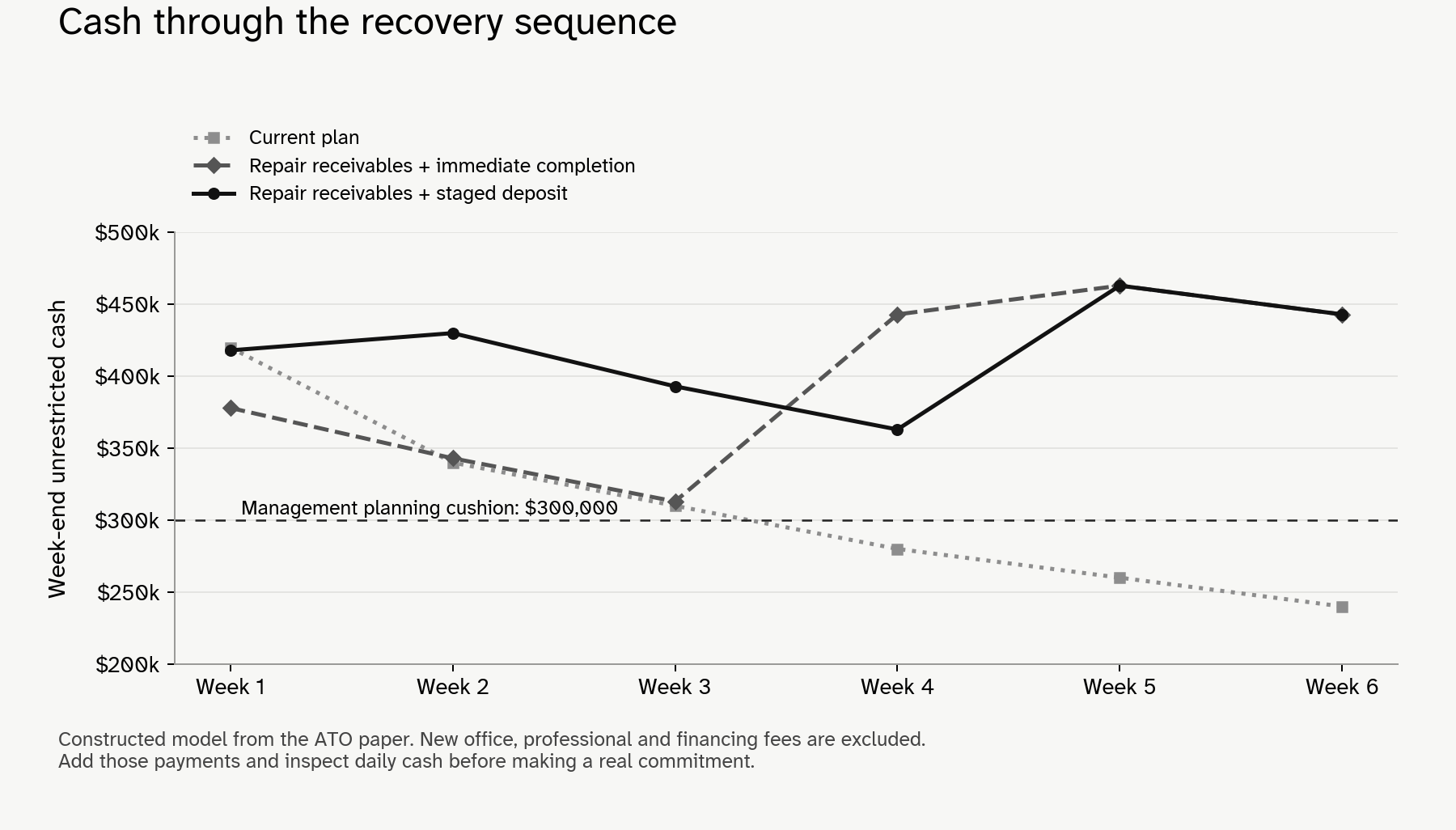
Completing the order immediately improves the final balance but takes cash down to $263,000 before the receipt arrives. Combining completion with the receivables work raises that low point to $313,000. Moving the $60,000 documentation receipt back one week then takes week-two cash to $283,000.
Change the conditions for spending
The alternative seeks an $80,000 customer deposit before purchasing the components, with the remaining $80,000 paid after shipment and acceptance.
The account owner obtains agreement and counsel reviews the terms. Before procurement proceeds, finance verifies that the deposit is available and operations confirms capacity and the remaining delivery conditions.
This plan finishes with the same $443,000 as receivables work combined with immediate completion. Its lowest week-end balance is $50,000 higher. That additional room exists during the work; it is not an extra $50,000 of final cash or profit.
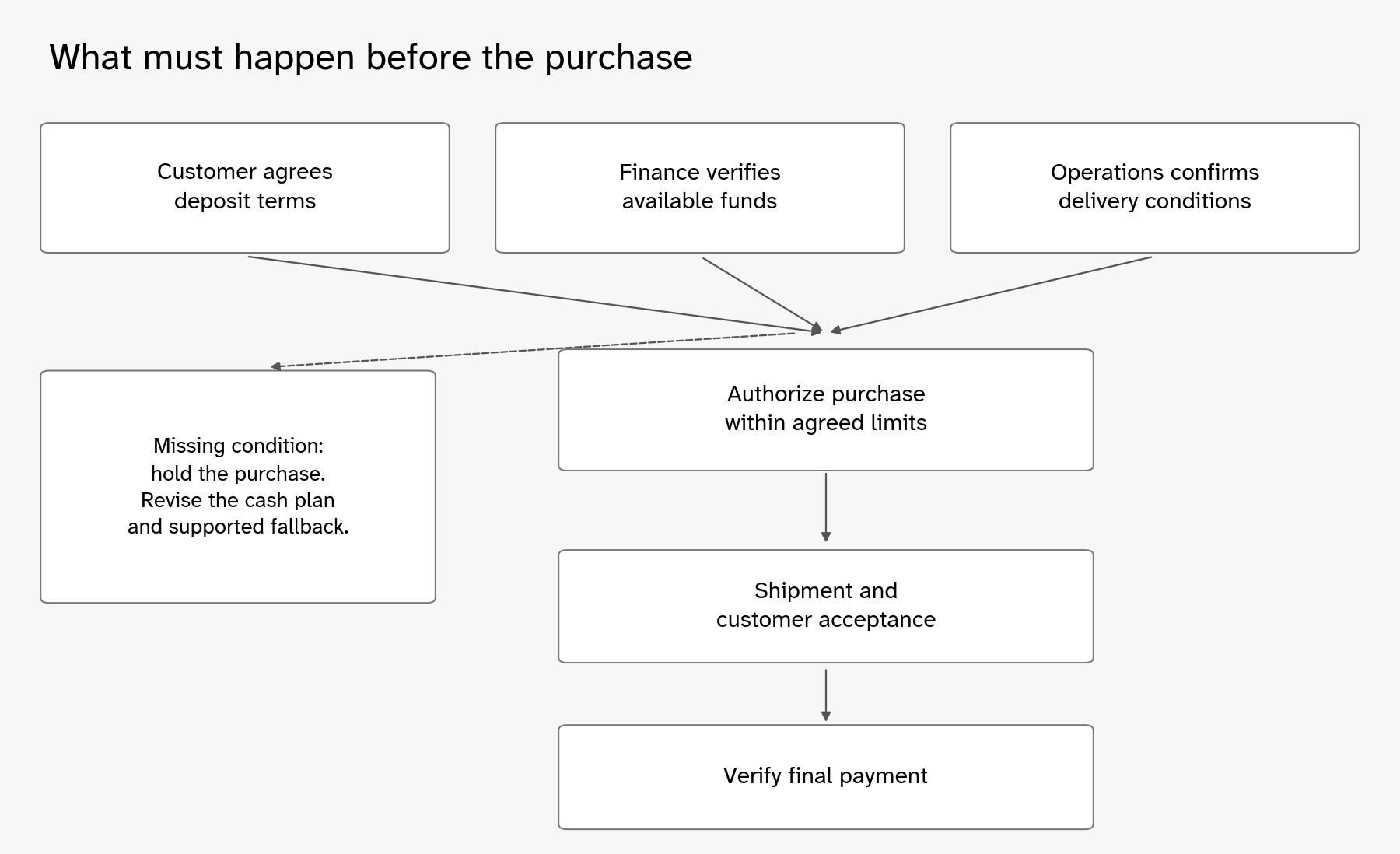
If the deposit does not arrive, the purchase stays on hold and the office updates the supported fallback. If customer acceptance fails, the associated receipt leaves the forecast until there is a new basis for it.
Daily timing also matters. A Monday payment and Friday receipt can appear in the same week while the company cannot fund the intervening days. The finance lead tests those dates and the obligations beyond the six-week extract.
What is an Agentic Turnaround Office?
An Agentic Turnaround Office coordinates a defined business recovery mission. It follows material decisions from source evidence and competing explanations through financial review, authorized action and observed execution. Software agents can support permitted evidence and monitoring tasks; accountable people retain business and professional authority.
Approving the component purchase is one decision. Establishing customer acceptance, funding the work and confirming payment are separate responsibilities. The office maintains those dependencies so that a changed condition reaches the people preparing to act.
Your authorized executives retain business authority. CXOJoe's systems and Turnaround Office role coordinates the operating investigation and execution. Qualified finance leadership owns the liquidity model and financial interpretation. Qualified legal or restructuring counsel handles legal advice and the constraints affecting commitments. Operating owners deliver the work.
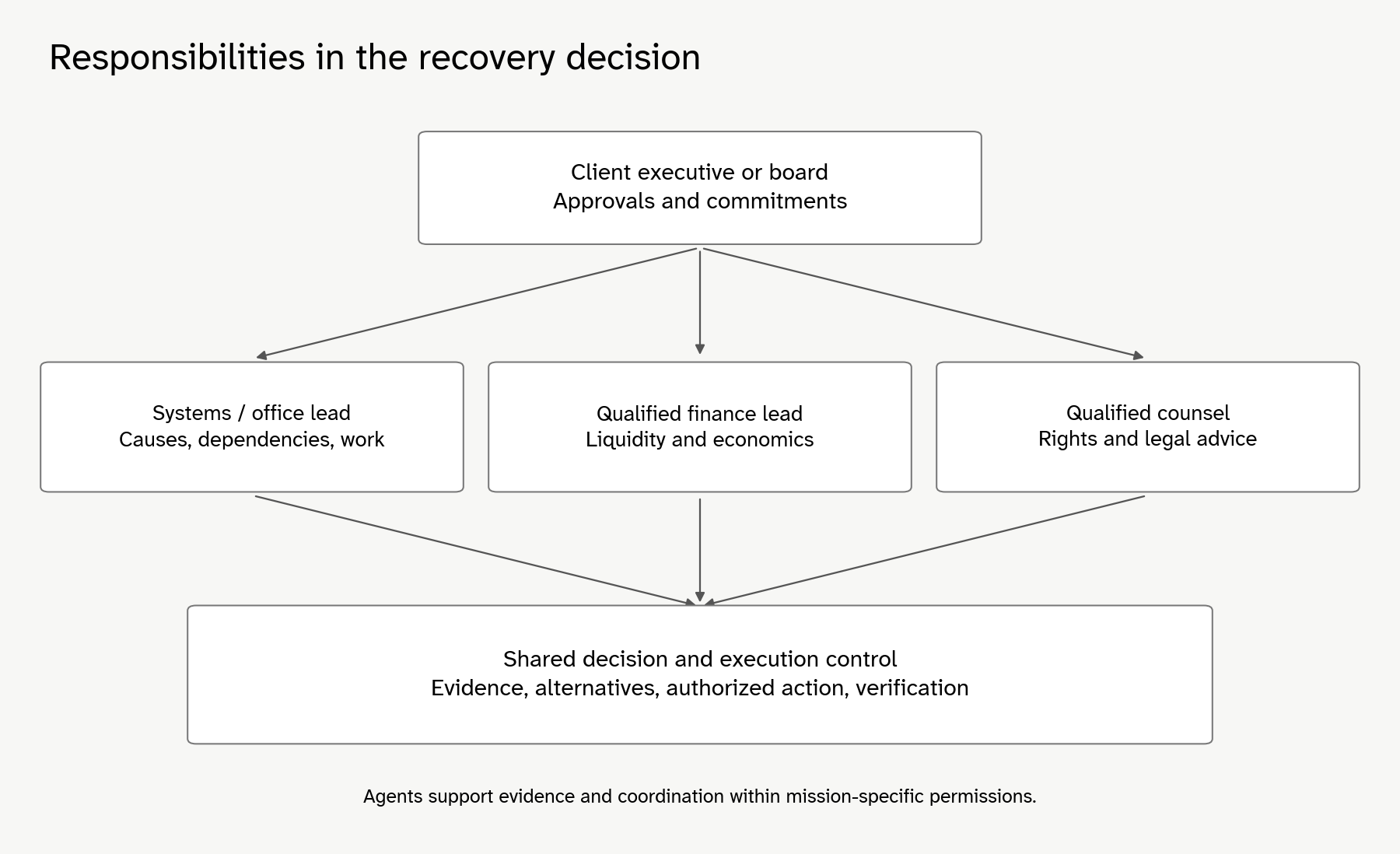
The engagement needs actual professional coverage and agreed decision rights. The title of the office does not itself establish a CFO appointment, legal representation or permission to bind the company.
Where AI agents can help
An authorized agent can compare invoice records with orders, shipment confirmations and acceptance documents. It can flag a mismatched amount, missing evidence or a forecast receipt whose supporting information has changed. Each exception needs a source that the reviewer can inspect.
The agent does not infer customer agreement, change commercial terms or approve spending. Those actions follow the company's authority structure.
Include setup, review, correction and maintenance when evaluating the agent. Test it against a competent manual process, including ordinary clean records and known exceptions. Measure material errors and accepted output at the same standard. The recovery mission should remain executable through existing systems and manual controls when automation is unavailable.
Get help with the problem you are facing
Several operating constraints are threatening the recovery
Discuss a Turnaround Office engagement when delivery, liquidity, operating performance and management capacity are interacting and the work needs active coordination. The initial discussion establishes the mission, next urgent commitment, sponsor and required professional coverage. Scope and fees follow that work.
Discuss your recovery situation
An imminent liquidity, legal, safety or regulatory exposure needs the responsible executives and qualified professionals immediately. It should not wait for a standard Diagnostic.
One recurring problem needs a clear explanation and plan
The CXOJoe Executive Systems Diagnostic provides two weeks of investigation and analysis for $5,800. We test the explanation, compare practical solutions and develop a detailed implementation plan with first actions, owners, costs, dependencies and measures. The plan explains the expected effect on profit, cash flow or the capacity to serve profitable demand, together with the assumptions to check.
Start the Executive Systems DiagnosticView the Diagnostic example
Read the research or share it with your leadership team
The Agentic Turnaround Office
A Systems-Engineering Architecture for Mid-Market Corporate Recovery
Josef Reed · CXOJoe
The 13-page working paper sets out the operating design behind this analysis. It includes the complete cash comparison, scenarios that reverse the decision, professional responsibilities and a method for testing agent assistance against capable manual work.
It presents a proposed design with reproducible scenarios. The paper explains its research basis, evaluation requirements and limitations.
Read the full paper onlineDownload the paper · 13 pagesDownload the executive brief · 3 pages
For an internal decision discussion, use the brief to bring the operating issue and cash consequences together. The full paper provides the assumptions and alternatives for people who need to examine the reasoning. The separate Diagnostic example shows the depth of an investigation into completed work and unresolved cash.
Questions before engaging CXOJoe
We already have a CFO and advisers. Where would this fit?
Establish which responsibilities are already covered and where operating work fails to move between them. CXOJoe's role is the operating investigation and coordination of decisions and execution. Finance and legal professionals keep their respective responsibilities.
Does this require new software?
No particular platform is required. An initial mission can use existing controlled records, a finance-owned model and a small number of decision records. New technology needs a defined task and evidence that it improves the work.
What information is useful for the first discussion?
Describe the problem, the business consequence and the next important deadline. Identify who owns the situation and what has already been tried. Confidential records can follow once scope and access arrangements are agreed.
How will we know whether the work is helping?
Agree on a baseline and mission-specific measures. These can include the time from a verified issue to an authorized decision, work completed with acceptance evidence, receipt-timing accuracy and rework. Include the effort consumed by coordination. Keep earlier collection, lower costs, additional revenue and released staff capacity as distinct results.
What does your business need to decide next?
Describe the commitment at risk and the date that matters. The first discussion should establish where CXOJoe's operating work would help and what an appropriate engagement requires.
Discuss your recovery situation
Initial market focus: Tampa, Lakeland/Polk and Orlando. Work elsewhere is considered according to the mission and its delivery requirements.
Research basis: The Agentic Turnaround Office, especially section 4 for the cash model and sections 3, 5 and 6 for responsibilities and execution. The accepted paper contains its formal references.